
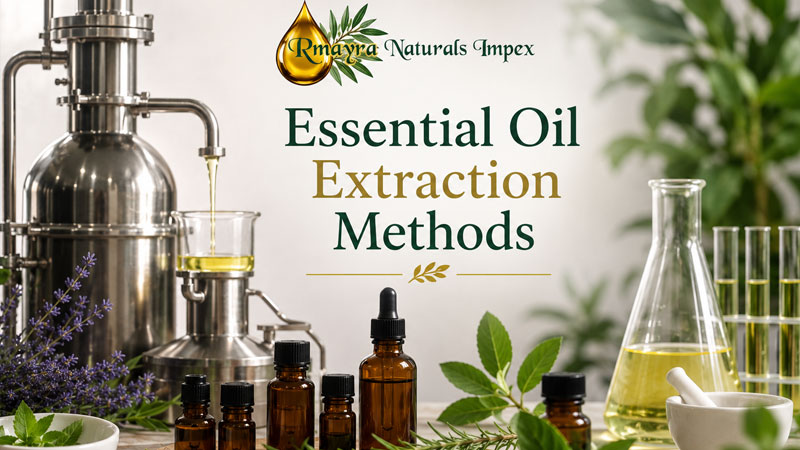
The method used to extract an essential oil directly affects its purity, chemical profile, aroma and suitability for different applications. Understanding extraction methods is not just academic — it helps B2B buyers make better sourcing decisions, choose the right grade for their formulations and ask the right questions to suppliers.
Here is a practical overview of the five key extraction techniques used in the natural oils industry today.
1. Steam Distillation
Steam distillation is the most widely used method for producing essential oils. It accounts for the majority of essential oils on the market — including lavender, tea tree, eucalyptus, peppermint, rosemary and many more.
How it works: Steam is passed through the plant material (leaves, flowers, bark, roots or seeds) in a still. The heat causes the volatile aromatic compounds to vaporise. The steam and oil vapour travel through a condenser where they cool back into liquid form. The essential oil, being lighter than water, separates naturally and is collected.
- Best for: leaves, herbs, flowers, bark, roots, seeds
- Produces: true essential oils with complete natural profile
- Advantages: no chemical solvents, produces pure oil, scalable
- Oils: lavender, eucalyptus, tea tree, peppermint, rosemary, lemongrass
Steam distillation has been used for centuries and remains the gold standard for producing pure essential oils without chemical residues.
2. Cold Pressed Extraction
Cold pressing is a purely mechanical process — no heat, no solvents. It is used primarily for citrus oils (extracted from the peel) and for carrier oils (extracted from seeds and nuts).
How it works: The raw material is mechanically pressed or centrifuged to squeeze out the oil. Because no heat is applied, the oil retains its full natural nutrient profile, colour and aroma.
- Best for: citrus peels (lemon, orange, bergamot) and seeds/nuts (coconut, almond, jojoba, sesame)
- Produces: cold-pressed essential oils and virgin carrier oils
- Advantages: retains maximum nutrients, natural colour and aroma
- Note: cold-pressed oils generally have a shorter shelf life than refined oils
3. Solvent Extraction
Some delicate flowers — like rose, jasmine, tuberose and lotus — are too fragile for steam distillation. Their aromatic compounds would be damaged or destroyed by heat. Solvent extraction solves this problem.
How it works: A food-grade solvent (such as hexane or ethanol) is used to dissolve the aromatic compounds from the plant material. The solvent is then evaporated, leaving behind a waxy substance called a "concrete." Further processing with alcohol removes the wax, yielding the final product — an absolute.
- Best for: delicate flowers that cannot withstand heat
- Produces: absolutes (more concentrated and richer than essential oils)
- Oils: rose absolute, jasmine absolute, tuberose absolute, champaca
- Used in: high-end perfumery, luxury skincare, premium aromatherapy
4. CO2 Supercritical Extraction
This is the most advanced and expensive extraction method. It produces exceptionally pure, high-quality extracts that are closest to the original plant's natural profile.
How it works: Carbon dioxide is pressurised until it becomes a "supercritical fluid" — a state between liquid and gas. In this form, it acts as a powerful solvent that dissolves the aromatic and active compounds from the plant. When the pressure is released, the CO2 evaporates completely, leaving behind a pure extract with zero solvent residue.
- Best for: high-value botanicals where maximum purity is essential
- Produces: CO2 extracts (also called CO2 selects or CO2 totals)
- Advantages: no heat damage, no solvent residue, complete aromatic profile
- Used in: premium skincare, nutraceuticals, pharmaceutical extracts
5. Fractional Distillation
Fractional distillation is a precision technique used to separate an essential oil into its individual chemical fractions based on different boiling points.
How it works: The oil is heated in a fractionating column. Different compounds vaporise at different temperatures, allowing them to be collected separately. This enables isolation of specific desirable compounds or removal of unwanted ones.
- Best for: refining and standardising essential oils
- Used to: isolate specific compounds (e.g. menthol from peppermint, eugenol from clove)
- Advantages: produces oils with targeted purity and consistency
- Common in: pharmaceutical and food-grade oil production
Which Method Matters to You?
As a B2B buyer, the extraction method directly affects what you are getting. Always ask your supplier which method was used and whether documentation (COA, MSDS) is available for the specific batch. At Rmayra Naturals Impex, we use all five methods depending on the oil, and we document the extraction process for every batch we supply.
Need Oils Extracted the Right Way?
We supply steam-distilled, cold-pressed, solvent-extracted and CO2 oils with full documentation. Get a quote today.
Request a Quote